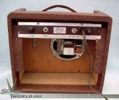
1959 Sears Silvertone #1451 Tube Amplifier Speaker Mystery

I have...nobody will touch this relic...
Maybe Ampmad or Greg?

Hey Ro Bear....

I don't think you could go wrong with speakers from Weber.


Last edited:


Because of their uniqueness and relatively short period of production, these guitar and amp-in-the-case packages are collectible. Currently, examples in excellent condition with fully working components (amp and footswitch included) are valued between $600 and $800. The cool thing about these packages is that you can use each piece individually. In other words, the guitar can be plugged into a different amp and the amp-in-the-case will work for any other guitar. Some packages from this era, like the Epiphone EA-8P Professional, only worked with the included guitar and amp.
 
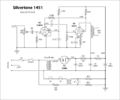
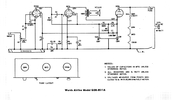
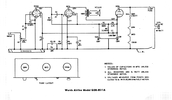
Silvertone Schematics can be found here. I was reading and it said the 1430 schematic is the same as the 1451


Interesting amp @Robert Herndon. Hope it's been made safe in the past, if not, @chilipeppermaniac has kindly linked the necessary information to do so properly, follow the Music Electronics forum recommendations (using linked components).
I like the small speakers from Weber, though I've used 8" rather than 6". When it comes to the choice between alnico or ceramic types, it depends on your personal preference. Both types can be had from Weber in early or late breakup, an alnico type will compress more than its ceramic counterpart as it's pushed. Some of their small speakers are also offered with your choice of either a 3.2 ohm or 4 ohm voice coil, you can read up on the difference on Weber's site.
Back to the amp's circuit, for anyone interested, note the way in which the pre-amp tube (12AU6) is biased. Note the cathode is grounded & the tube is "grid leak" biased by the 15 megohm resistor between the control grid & circuit ground. This is a very old method of biasing voltage amplifying tubes & is rarely seen in guitar amps. Cheers
 
My first amp. The cone in the original speaker fell apart years ago and got replaced with what looks like a poly cone automotive speaker.

How would I determine what the correct ohms rating would be without the original speaker and what would be a good speaker for this amp??? Looks like a 6" round to my eye.

Wish I could throw a reverb tank in this thing!!!

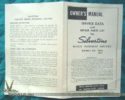
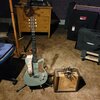
View attachment 17247 View attachment 17248 View attachment 17249 View attachment 17250
The amp was made for Sears by Danelectro...
To answer the questions
The output is 3.2 ohm and it is meant to connect to a 4ohm speaker (the speaker will read 3.2 ohm with an ohm meter.)

However be warned :eek: that this amp is extremely dangerous shock hazard unless it is modified with an isolation power transformer.
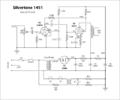
In other words:
The power from the wall receptacle is connected directly to the chassis.
It can shock the sh it out of you.

Original:

1653951212278.png

Modified for safety:

1653951309194.png
 
The output is 3.2 ohm and it is meant to connect to a 4ohm speaker (the speaker will read 3.2 ohm with an ohm meter.)
It is true that 4 ohm (voice coil impedance) speakers will have a (DC) resistance in the vicinity of 3.2 ohms (though not always exactly 3.2 ohms), however there are also speakers that have a voice coil "impedance" of 3.2 ohms. It is explained in the following Weber Q & A. Scroll down to the question

"I have several old Fender Champ amps from the 50's and 60's. I thought I had the speaker impedance thing figured out until I saw that you offer 8" speakers in both 3.2 and 4 ohm. I always thought they were all 4 ohm and the 3.2 was either a misprint, or a mistake."

There you'll find 3.2 ohm impedance speakers explained.
That was a damn long winded "question", wasn't it. Cheers
Edit:
I have a 3.2 ohm impedance alnico speaker in my 5f1 Champ type build, along with a 17k ohm primary impedance OT, as Leo used in the very earliest Champs. Cheers
 
Last edited:
In other words, it's like pissing on an electric cattle pasture fence?
When I was a little kid, I was shocked many times by this type of amplifier.

All you gotta do is touch the chassis with one hand, and touch ground (like a water pipe) at the same time.

This type "hot chassis" was eliminated by safety code changes.
The third wire (ground wire) (earth wire) was added to appliances, to prevent people from being shocked.

A lot of people died from this, before the codes were changed.
 
Back
Top