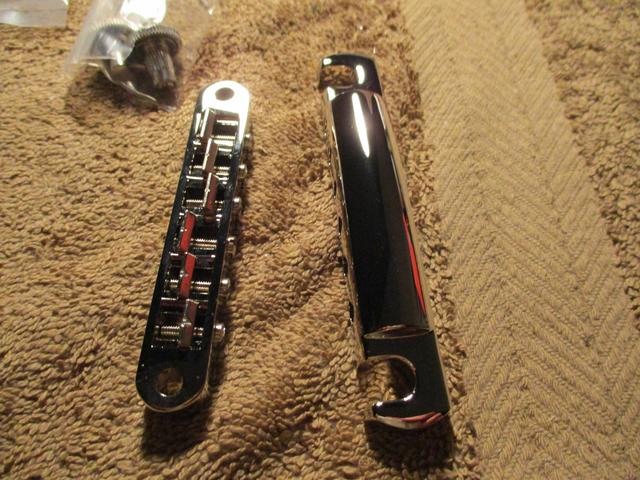
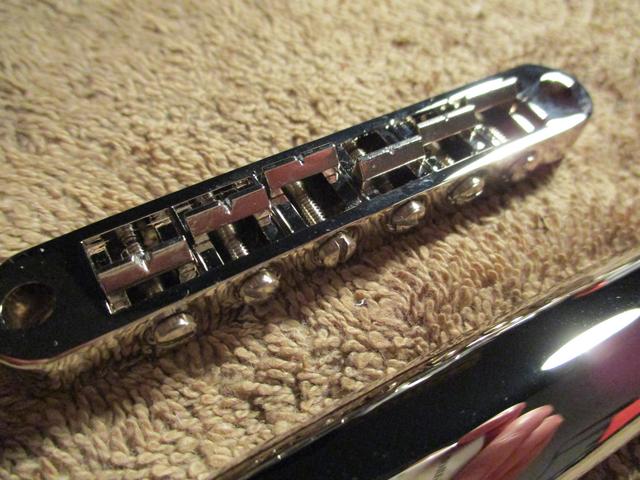
replacing saddles

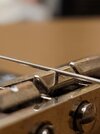
If it's a wireless ABR, you just pop the intonation screws straight up with a non-marring tool.

You can save a lot of time by snapping a pic, then recording all the saddle positions with a slide caliper. Then, putting them back to the same measurement will get you really close.


Most new saddles are blank and you will need to slot them.

If you don't have the proprietary files, buy a welding tip cleaner and slot about .004" larger than your string gauge.

Thanks for the tips. The E string saddles already fall out on their own so I figured the others would just pop out, I thought I'd just cross that bridge when I got there, lol. I have a nice set of stewmac nut files, those will work, right? I already planned on having to notch them, I just hope I get them dead center on each one, that's all I'm really worried about.
 

Don't even waste time & money on saddles just buy a new bridge.
Ive bought a couple of these and they're fantastic for the price.
You can pay more but why bother.
Im not easy to win over either.

I got the Wilkinson bridge yesterday and installed it last night. It's A LOT better than the tonepros I tried. It fits a little loose on the original post, but I can't tell anything negative because of it. It feels better under the palm than the original. I don't see any reason not to keep it on there, but since I ordered new saddles for the original bridge I will try those when I get them.
 
Last edited:
I still think Graph Tech is actually Gotoh.
I think all the parts they sell come from China or Japan.

I still see nothing wrong with using Gibson parts for a Gibson bridge.

But I still think that using metal saddles or a metal nut...does not actually have any advantage over bone, nylon, or other alternative material.
The non-metal parts always seemed to work better, and sounded better, had better sustain.

The most legendary guitars in all of history --- used nylon nuts.


Well I heard back from Graphtech today. Here's what was said from the owner of the Company himself.


Hi Norman,


Thanks for the email. Well, why Resomax in the first place? Back in the 1950's , it was the golden era on tone for Gibson... and then the 60's came along and it all changed ... a lot of guys said it was the wood, the craftmanship, etc.... but what they didn't think about was the bridge... in the 50's Gibson used aluminum for there bridges.... great, rich tone.... the one issue they did have... in about 5 or so years, maybe more.. the bridge would start sinking (or flattening) in the middle... the aluminum wasn't strong enough for tune o matic style bridge...... around 1959 to 61 .... all around the world... zinc diecasting was introduced to the world.... the molds to make the parts were a 1/2 the cost, and the molds lasted 5 times as long, the zinc cost was waaaay lower than aluminum, and zinc was so much easier to plate than aluminum..... Car parts, door knobs, you name it, everybody changed... including the guitar industry..... it wasn't the trees or the craftmanship that was the difference of a 1958 LP compared to a 1965 LP.... it was the first thing the strings were vibrating on, the aluminum bridge... So.... fast forward.... we came up with the Resomax material, which is aluminum and some additives to make it stronger... not really rocket science , just putting pieces of the puzzle together.... We do get our die casting for Resomax housing done by a company located in China that has nothing to do with the guitar industry, as most stuff made in China for the guitar industry is all about price, not quality. And... Gotoh, made in Japan is very well made. It's becoming not where it's made as who is making it...


Well, that's my two cents.... we are having a huge snow storm and temperature drop in Vancouver, so I'm helping out today on the help desk.... totally enjoying it


Have a happy New Year Norman and thanks for sticking up for a company that pushes the boundaries, but with respect to tradition!


Dave
 

HE GRAPH TECH STORY​


In the early 80's, Dave Dunwoodie, Graph Tech's President, was mid-performance at a gig in his hometown of Vancouver, Canada. Hitting the tremolo bar on his first Fender® Strat (he was a Gibson® man) during a guitar solo, he was immediately introduced to the problem of string binding on traditional guitar nuts
1640228066018.png

Graph Tech branded products sit at the top level of each product category we enter, offering patented technologies through innovative research, development and testing accomplished within our laboratories in British Columbia, Canada.

About us​

Graph Tech Guitar Labs is the first high performance guitar component laboratory of its kind, offering the guitar industry a powerful research and development facility, trusted and utilized by the majority of major guitar manufacturers, including: Fender, Gibson, Godin, Epiphone, Carvin, Taylor, Walden and Yamaha
 
in the 50's Gibson used aluminum for there bridges... it wasn't the trees or the craftmanship that was the difference of a 1958 LP compared to a 1965 LP.... it was the first thing the strings were vibrating on, the aluminum bridge...
Dave

Read my old posts. I've always used aluminum bridges and tailpieces on Gibsons.

My 2021 Gibson Les Paul 50's Standard has an aluminum ABR-1 and Tailpiece from the factory...
 
And just let me add that GraphTech sells high quality bridges, and look at the Company's that buy from them..


: Fender, Gibson, Godin, Epiphone, Carvin, Taylor, Walden and Yamaha
 
[IMG alt="DC1"]https://www.thegearpage.net/board/data/avatars/m/16/16674.jpg?1443578606[/IMG]

DC1

Member​

Messages15,391
Feb 5, 2009
Some of you may remember my saga of the collapsed abr-1 on my friends Heritage 150 (think LP). I looked around and decided to try the new Graphtech Resomax bridge because it looks very well made, is very light, and I have heard great tone stories about it from people I know.

I purchased this model:

Collections

The bridge is made of aluminum and utilizes their proprietary material for the saddles, which they claim improves tone and sustain and reduces string breakage. (BTW, the new material conducts electricity so no worries about grounding problems)

When I took the bridge out of the packaging I immediately was impressed with its extreme light weight and quality of design and machining.

Did I mention I HATE Tune-O-Matics?

:BITCH :BITCH :mob

Poorly made, loose, semi-connected imprecisely fitted, made of pot metal (OK Zinc alloy) JUNK!

Well the Resomax is a thing of beauty and everything fits and works like the shifter on a new BMW. What a welcome change!

We were replacing an ABR-1, so the studs line up fine, but you must remove the originals and install the Resomax included socket and stud. Much better, and a beautiful fit with the bridge. Some careful drilling is required.

Let me make an aside here and mention that I came up with a way to raise the tailpiece (I use TonePros tailpiece studs BTW) yet still bolt the tailpiece down solidly with no rattling around in the threads. You just put a jam nut on the threads! In my case, the nut by itself raised the tailpiece enough so I did not need any more adjustment than that to get a good string angle, and I did not need to resort to "wraparound" loading of the strings to get both the angle right, and the tailpiece solid. Works like a dream.

So I got the Resomax on, the tailpiece on, and setup the string height and intonation, and was immediately greeted with a much more lively sounding guitar. This thing works. Graphtech claims it removes the 2K spike most metal bridges add, and that is what I am hearing as well. A very clear, wide-range and articulate (not tinny) tone. Impressive.

Plugged it into my JCM2000 DSL100 and Matchless 4x12 and found that the tone translated nicely into amplified mode. Very clear, and beautiful sustain
 
You guys are giving me a lot to think about here. What I thought was going to be a simple thing is turning into a can of worms. :blink:

Not at all...

I setup/service anywhere between 5-10 guitars a week. I have installed every piece of gear you can name.

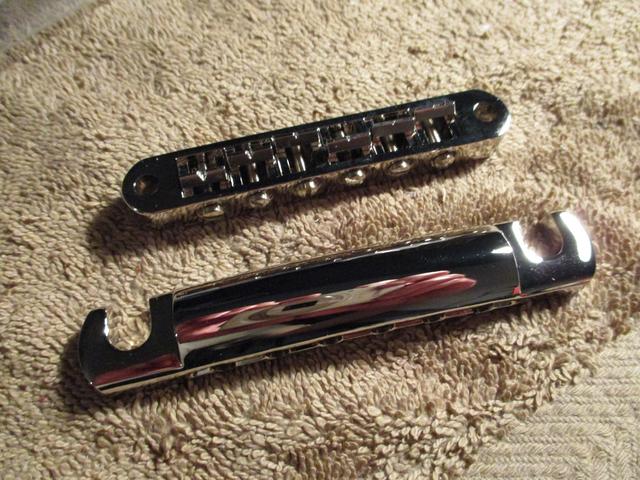
IMHO, the best bridges are the ones from Philadelphia Luthier Tools. Aluminum Nashville less than $30.00


Same with the aluminum tailpieces:


Both of these are standard on my 2021 Gison les Paul 50's Standard....
 
Not at all...

I setup/service anywhere between 5-10 guitars a week. I have installed every piece of gear you can name.

IMHO, the best bridges are the ones from Philadelphia Luthier Tools. Aluminum Nashville less than $30.00


Same with the aluminum tailpieces:


Both of these are standard on my 2021 Gison les Paul 50's Standard....

After everything I've read today I'm not even going to try to put new saddles on the original bridge. I think it's not worth going to be worth the the trouble. Plus I did a little experiment today. I don't know if you remember me saying the original bridge pickup sounded plinky and blah when palm muting for high gain stuff? Well as of a couple days ago I posted that I put the Wilkinson bridge I ordered on the guitar so today I decided to try the original pickups again and to my surprise that plinky sound is gone. I am very happy with the way the Burstbuckers sound in it now. I knew the bridge played a role in the over sound, but I didn't realize it played such a big role until all this came up. I'm really learning a lot here.

Edit: even tho the Wilkinson bridge sounds a lot better than the original bridge the description for material just says "metal", so I ordered the aluminum bridge from Philidelphia Luthier. I went ahead and ordered the tail piece too since I don't know what the original is. So now I'll see what difference the aluminum makes.
 
Last edited:
After everything I've read today I'm not even going to try to put new saddles on the original bridge. I think it's not worth going to be worth the the trouble. Plus I did a little experiment today. I don't know if you remember me saying the original bridge pickup sounded plinky and blah when palm muting for high gain stuff? Well as of a couple days ago I posted that I put the Wilkinson bridge I ordered on the guitar so today I decided to try the original pickups again and to my surprise that plinky sound is gone. I am very happy with the way the Burstbuckers sound in it now. I knew the bridge played a role in the over sound, but I didn't realize it played such a big role until all this came up. I'm really learning a lot here.

Edit: even tho the Wilkinson bridge sounds a lot better than the original bridge the description for material just says "metal", so I ordered the aluminum bridge from Philidelphia Luthier. I went ahead and ordered the tail piece too since I don't know what the original is. So now I'll see what difference the aluminum makes.

I've put those aluminum bridges and tailpieces on all my les pauls and have installed many for clients. They (to my ear) offer a more complex tone. It's very loud acoustically and it serves to brighten the guitar to some extent.

It's true that the highly sought after 59's had aluminum parts!!!!
 
After everything I've read today I'm not even going to try to put new saddles on the original bridge. I think it's not worth going to be worth the the trouble. Plus I did a little experiment today. I don't know if you remember me saying the original bridge pickup sounded plinky and blah when palm muting for high gain stuff? Well as of a couple days ago I posted that I put the Wilkinson bridge I ordered on the guitar so today I decided to try the original pickups again and to my surprise that plinky sound is gone. I am very happy with the way the Burstbuckers sound in it now. I knew the bridge played a role in the over sound, but I didn't realize it played such a big role until all this came up. I'm really learning a lot here.

Edit: even tho the Wilkinson bridge sounds a lot better than the original bridge the description for material just says "metal", so I ordered the aluminum bridge from Philidelphia Luthier. I went ahead and ordered the tail piece too since I don't know what the original is. So now I'll see what difference the aluminum makes.

You will need to slot that bridge. Very, very easy to do. You can measure across to find center. A set of welding tip cleaners does an awesome job. It's what I use to slot saddles because I love the round profile...

Ok,

On the wound strings, you want 1/2 of the string down in the slot. On the plain strings, I like them to be flush with the top of the slot. This keeps them from getting 'popped out' when playing hard and fast...

20200907_031507.jpg
 
You will need to slot that bridge. Very, very easy to do. You can measure across to find center. A set of welding tip cleaners does an awesome job. It's what I use to slot saddles because I love the round profile...

Ok,

On the wound strings, you want 1/2 of the string down in the slot. On the plain strings, I like them to be flush with the top of the slot. This keeps them from getting 'popped out' when playing hard and fast...

View attachment 78235

So I shouldn't use nut files?
 
I was really surprised the Tonepros bridge I tried killed the tone so much. I don't understand why it would, I've always had good results from Tonepros, all my other guitars have tonepros bridges and they are great. It was literally like I had the tone knob rolled down compared to the original ABR. :confused2:
DirtySteve, what did you do with the dead sounding Tone Pros? Also, what exact new bridge/tailpiece is it you replaced it with?

The reason I ask is my ES 135 needs a new bridge or at least saddles. ( previous owner had slots all jacked up)
Of course I also need one Gold Bridge ( Metric) for my Washburn HB 30 ) as well.
 
Last edited:
DirtySteve, what did you do with the dead sounding Tone Pros? Also, what exact new bridge/tailpiece is it you replaced it with?

The reason I ask is my ES 135 needs a new bridge or at least saddles. ( previous owner had slots all jacked up)
Of course I also need one Gold Bridge ( Metric) for my Washburn HB 30 ) as well.

The Tonepros bridge went straight to the trash can after trying it a second time with the same results. I have a Wilkinson on it now that 66SS396 linked in post #14 and it's not bad, better than the original ABR-1.

BTW that is the second Tonepros bridge I bought that I couldn't use. I don't know why, all my other guitars with a TOM bridge have Tonepros and they are fine. But this one I just tried and another one I bought last year were not good.
 
Last edited:
Back
Top