100 Watt Marshall 2203 Slave Amp Build

Cadorman

Ambassador of the Catocaster
Country flag
Hey guys, as has been discussed elsewhere I am starting to put together a 800 style slave amp. I'm using a 900 chassis and transformers and part of a 2203 turret board.

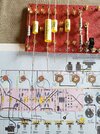
Right now I just want to verify that I have the foil ends of these 4 caps in the correct direction.
20210730_110805.jpg
The line on the cap indicates the input side for direction of flow. The line on the layout is where I cut the board.

On the front panel I will only have power and standby, master volume, presence and resonance. The back will have the loop send and return, 2 speaker jacks, and the usual power stuff.
 
Hey guys, as has been discussed elsewhere I am starting to put together a 800 style slave amp. I'm using a 900 chassis and transformers and part of a 2203 turret board.

Right now I just want to verify that I have the foil ends of these 4 caps in the correct direction.
View attachment 71461
The line on the cap indicates the input side for direction of flow. The line on the layout is where I cut the board.

On the front panel I will only have power and standby, master volume, presence and resonance. The back will have the loop send and return, 2 speaker jacks, and the usual power stuff.
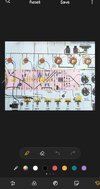
You might not be able to trust the markings on the caps.
Usually I test them to find the outside foil.
But if the marks are correct, the outside foil should be facing away from the next grid.
First .02 on the left looks correct.
Second .1 uF is backwards.
Two .02 on the right look correct.

But understand, it makes a bigger difference in the preamp stages, where there is more likelihood of AC magnetic field from the filaments entering the audio path.

Many people have forgotten how important the outside foil can be to keep the noise down to minimum.
Many people say it makes no difference.
Of course they are wrong.
There is a measurable difference in noise, especially AC buzzing noise.
But to find this difference one sometimes needs to make careful measurements.


But also keep in mind that these capacitors DO NOT have polarity.
They DO have the outside foil, which should face the correct way to keep the noise minimized.

So please don't call this "polarity," cause it's not polarized.

Also remember that the outside foil may not be marked correctly on the cap case. It might be reversed by accident.

Just one more thing;
The voltage rating of the PI plate coupling caps: should usually be 600 volts. Not 400.
This is a really common mistake that results in the coupling caps leaking or shorting out from over voltage.
(a lot of amps like Boogie have under rated caps installed) Not a good plan.
I see this mistake quite frequently.
I see these caps short out quite frequently too, because they are so frequently under rated.
 
Last edited:
Thank you for that info @Amp Mad Scientist .
View attachment 71473
Take a look at the 27k resistor I have circled in red. I don't have one. What will happen if I use a 33k in place of it? Everyone is invited to reply.
You won't have enough bias voltage, the tubes will run too hot. The current will be too high.

You can make a resistor by putting 2 resistors in parallel.
R1 X R2
--------- = total resistance parallel
R1 + R2

If R1 is 33K and R2 is 220K then
R1 X R2 = 7260000000
---------
R1 + R2 = 253000

7260000000 / 253000 = 28.695 K --------Which is a lot closer to 27K.
 
You won't have enough bias voltage, the tubes will run too hot. The current will be too high.

You can make a resistor by putting 2 resistors in parallel.
R1 X R2
--------- = total resistance parallel
R1 + R2

If R1 is 33K and R2 is 220K then
R1 X R2 = 7260000000
---------
R1 + R2 = 253000

7260000000 / 253000 = 28.695 K --------Which is a lot closer to 27K.
Well, I have to order a few parts anyway, so I will get the correct Dale resistor for that position.
 
Hey guys, as has been discussed elsewhere I am starting to put together a 800 style slave amp. I'm using a 900 chassis and transformers and part of a 2203 turret board.

Right now I just want to verify that I have the foil ends of these 4 caps in the correct direction.
View attachment 71461
The line on the cap indicates the input side for direction of flow. The line on the layout is where I cut the board.

On the front panel I will only have power and standby, master volume, presence and resonance. The back will have the loop send and return, 2 speaker jacks, and the usual power stuff.
I like the Bifurcated turrets.
 
You might not be able to trust the markings on the caps.
Usually I test them to find the outside foil.
But if the marks are correct, the outside foil should be facing away from the next grid.
First .02 on the left looks correct.
Second .1 uF is backwards.
Two .02 on the right look correct.

But understand, it makes a bigger difference in the preamp stages, where there is more likelihood of AC magnetic field from the filaments entering the audio path.

Many people have forgotten how important the outside foil can be to keep the noise down to minimum.
Many people say it makes no difference.
Of course they are wrong.
There is a measurable difference in noise, especially AC buzzing noise.
But to find this difference one sometimes needs to make careful measurements.


But also keep in mind that these capacitors DO NOT have polarity.
They DO have the outside foil, which should face the correct way to keep the noise minimized.

So please don't call this "polarity," cause it's not polarized.

Also remember that the outside foil may not be marked correctly on the cap case. It might be reversed by accident.

Just one more thing;
The voltage rating of the PI plate coupling caps: should usually be 600 volts. Not 400.
This is a really common mistake that results in the coupling caps leaking or shorting out from over voltage.
(a lot of amps like Boogie have under rated caps installed) Not a good plan.
I see this mistake quite frequently.
I see these caps short out quite frequently too, because they are so frequently under rated.


I learned of this Outer Foil directional positioning scenario of caps in my self studies and through at least one you tube presenter who has a channel called Mr Carlson's Lab
 
Last edited:
 
You will really see polarized caps for audio coupling in solid state circuits, not usually tube circuits.
Tube circuits used non-polar caps for audio coupling usually.

But some people call the outer foil "polarized," which it is not.
Common misunderstanding.
The direction matters for noise but not for polarity.

The outer foil acts like a shield and blocks the magnetic fields from the filament wires and power transformer.
The filament wire has a magnetic field around it. The transformer has a magnetic field.
When this magnetic field reaches the audio path, you will hear buzzing or hum in the audio. The hum is amplified just like the guitar is amplified....
 
Last edited:
Hey guys, as has been discussed elsewhere I am starting to put together a 800 style slave amp. I'm using a 900 chassis and transformers and part of a 2203 turret board.

Right now I just want to verify that I have the foil ends of these 4 caps in the correct direction.
View attachment 71461
The line on the cap indicates the input side for direction of flow. The line on the layout is where I cut the board.

On the front panel I will only have power and standby, master volume, presence and resonance. The back will have the loop send and return, 2 speaker jacks, and the usual power stuff.
Good to see you've started on the slave amp.
Regarding the band denoting the capacitors outer foil, with Sozo caps you can be pretty well certain that it is oriented correctly, I've never found one that isn't & would be interested to hear if you do.
So which way should the cap be oriented in a circuit??? The outer foil should be oriented toward the lower impedance side of the circuit the cap is placed in. So generally, when decoupling your common pre-amp gain stages (voltage amplifiers), which includes the PI, the outter foil band will go toward the plate of the valve being decoupled. In these cases the DC plate voltage acts to shield the cap, just like using ground.
When it comes to cathode follower driven tone stack's things get a little fuzzy. Which side of the circuit is of lower impedance can be dependant on how the tone controls are set. As such we see people orient them either way in this application. Any other type circuit, outter foil to the lower impedance side of the circuit. Hope this helps. Cheers
 
Last edited:
Ivan and Ampmad etc, I revisited a you tube video I posed a question in as I viewed the lesson. I will see if I can find my question and then the replies from the you tuber and one of his viewers. I am nighttrain022

Mr Carlson's Backwards Caps.JPG
 
Last edited:
Back
Top