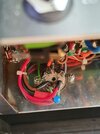
Tube Swap - how would you do it?

Things to try:
With the amp fully on, and a guitar plugged in, try gently rocking the tube around (without the heat shield of course). What do you hear?

With the amp fully on, and a guitar plugged in, use a chopstick or a wooden skewer and try to move those wires or any of the other components that are directly attached at the socket. What do you hear?

With the amp OFF, look for any deformaties of the individual metal sockets. I don't know if it's possible, but maybe some excess solder has oozed into any of the individual metal sockets thus compromising the tubes installation. Clean with electronic contact cleaner, the individual metal sockets. Make sure a tube pin will have a very snug fit in each of those metal sockets

All good ideas, thanks. I'll get the wife to help me... :D

Sorry to hear you are having troubles Mr Grumpy, & time zones are a pain in the ass. Don't sweat the V1 tube pins being bent upon removal from the socket, it happens frequently. An easy way to straighten them is to remove the guts from a ball point pen (biro) & place the outter plastic tube part of the pen over each pin (one at a time) that needs straightening. Or use any similar small cylindrical item you may have. The pins are quite easily straightened in this way.
Can we possibly get a couple of close-up pics of the V1 socket? Sysco as always has given some good advice. Oh, can we also see pics of the V1 mounting discrepancies? Hopefully we can make some progress. Cheers

I think it's a V1 issue. Although, we have to bare in mind that I don't know what I'm talking about...

Thinking things over, last night and this morning, there's a couple of areas I was considering:

1) the green preamp tube was completely stable all the time it was in the amp; on all attenuator settings; sounded clear and fine; better sounding than the original JJ, and no issues at all. The yellow preamp tube was a monster, lots of gain, changed the amp from a VOX sound with very limited OD to quite a Marshall-gainly level (though different sound), and the amp didn't like it with any gain on - sounded great, but a very narrow and limited range of use. But, again, the amp was stable and consistent with its power output. The only slightly weird thing was the power output difference between the two tubes was huge. I put the JJ back in to get a reference before I tried the EL84s, and that's when the problems started, lots of jumping around of power levels often with a bit of a thumping noise before the change, often happened as I turned the volume up... I wonder if it was connected to the tube? Later today, I'll put the yellow preamp back in and see where we are.

2) can I take the metal preamp housing off completely - both parts? only the 'lid'? It's angled and difficult to get the preamp tubes in cleanly, sometimes they sit right sometimes they don't feel right - the power amp base is flush, easy access and sits perfectly. The preamp 'housing' not so, it seems to be pushing forces upon the tube, so I'd like to remove it - is that ok? (the base part which screws into the amp housing too?)

this method may have merit?

It was close to that; I needed to practice my deep breathing exercises for 5 minutes - and I'm an exceptionally calm person, rarely get angry, well, never really...
 
2) can I take the metal preamp housing off completely - both parts? only the 'lid'? It's angled and difficult to get the preamp tubes in cleanly, sometimes they sit right sometimes they don't feel right - the power amp base is flush, easy access and sits perfectly. The preamp 'housing' not so, it seems to be pushing forces upon the tube, so I'd like to remove it - is that ok? (the base part which screws into the amp housing too)
The removable top (lid) & it's base (socket mount bracket) form a shield around the tube. Many people leave the removable part off in the interest of tone, so yes, that can be left off.
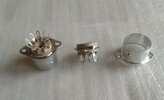
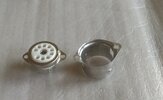
That the actual socket is not centrally located in the base mounting bracket is not a good thing & the manufacturer should not have used it. As you can see, the tube is a neat fit in the base with very little room between the two. That it is putting a sideways loading on the tube could well be causing pin contact issues. It depends on the actual valve socket type on whether that flange part of the mounting bracket can be removed or not. Some, like these
IMG_20200409_120722.jpgIMG_20200409_120741.jpg
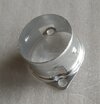
have a mounting bracket that is seperate from the lower flange part of the shield, which would make removal of this flange part
IMG_20200409_121616.jpg
possible. Other types however do not have a seperate mounting bracket, so removal of this part isn't possible. Cheers
Edit:
I'll get back to you later this afternoon, I'm currently masking & sanitizing up in order to go to the shops (I take a spray bottle of methylated spirits with me too). Cheers
 
Last edited:
lot of jumping around of power levels often with a bit of a thumping noise before the change, often happened as I turned the volume up... I wonder if it was connected to the tube?
Yes, the volume control (& tone control) are connected between the pre-amp tube's two triodes, so after the first half of V1 (V1a) & before the second half of V1 (V1b).
Chopsticking around the V1 socket (carefully poking & prodding around the wiring connected to the valve socket with something that is non-conductive, while the amp is turned on) may be worthwhile. Keep your free hand behind your back while doing this (avoids the possibility of having current accidentally passing through your heart). Let us know how you make out. Cheers
 
Ivan, I can understand why an American, in this case Sysco, would want to kill me..., but why would a nice friendly Australian want to kill me???

That's my mission for today: 1) remove the housing as much as I can to get flush 12ax7 connections; 2) use a pen as you suggested to get my greeny legs sorted out; 3) insert greeny; 4) chop stick around while standing on my right leg and my left hand behind my back and a clamp on my right nipple connected to an earthing foundation conduction rod pilled deep towards the centre of the Earth's core... I have some hope after you explained the v1a/v1b setup - the issues do seem to be right in that space.
 
Last edited:
Ivan, I can understand why an American, in this case Sysco, would want to kill me..., but why would a nice friendly Australian want to kill me???

That's my mission for today: 1) remove the housing as much as I can to get flush 12ax7 connections; 2) use a pen as you suggested to get my greeny legs sorted out; 3) insert greeny; 4) chop stick around while standing on my right leg and my left hand behind my back and a clamp on my right nipple connected to an earthing foundation conduction rod pilled deep towards the centre of the Earth's core... I have some hope after you explained the v1a/v1b setup - the issues do seem to be right in that space.
It does sound dangerous doesn't it, & very much can be if done in a careless manner. If done sensibly though, using something like a long plastic chopstick (don't use a bamboo one) so that you are not actually physically close to to the circuitry, the possibility of harm is greatly reduced. Cheers
 
Operation Chokstick Suicide has begun...

Step 1, used a biro to straighten the legs on the Sylvania yellow and green 12ax7 - worked brilliantly; thanks for the tip, Ivan. I placed the green tube in and took the JJ out (as, I'm not sure that JJ preamp tube isn't the problem).

Step 2, got me chopstick ready, took a couple of pictures and put the phone on it's stand.

20200409_164757.jpg

Step 3, took the wooden (not bamboo) chopstick and pushed about the soldered connections.

BANG!

:io:


The bloody phone fell off it's stand and crashed onto the desk right at that moment, I kid you not! :p

So, a couple of intakes of breath, picked up the phone, placed it carefully on the stand, then took a couple more deep breathes and back to Operation Chopstick Suicide.

My feeling now is that the actual base plate of the preamp tube is ok, it is flush, but the attachable cover is problematic, bent, twisted, so that has been removed and placed in the bottom of the cupboard.

Next, you see that blue thing connecting two wires, is it a capacitor?, at 6 O'clock, it was down on the plate, maybe not an issue, but maybe there were some bare wires touching the plate?, so I gently lifted it up (via chop stick, not finger).

20200409_164627.jpg

Next, below, see that silver solder at 12 O'clock, well it has wired connected behind, and if it was brought forward a tad, everything got pretty noisy, and if I pushed it back a tad then the sound went out. So, I reckon, that must do something related to the sound... :) I just very gently manipulated it into a central, straight up, position, so the amp wasn't noisy, i.e. static, general noise, but the volume on the amp worked fine. If I was gonna think about resoldering anything (and, I am most certainly NOT, then it would probably be that.
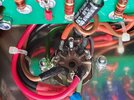
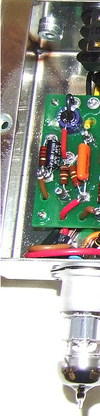
20200409_163036.jpg

Result:

There's a lot more gain - we have full on punk rock distortion in this amp now. The Mullard EL84 is also in. The clean and low OD character is the same as it ever was, but there's loads more gain. It's noticeable that the gain sounds good through the 5w and 1 w settings, but not great (I wouldn't use it...) on the 1/4w and 1/8w settings which you gotta expect with the extra compression characteristics of the lower attenuator settings. The amp rocks hard now! Actually, I did want a nice crunch OD and perhaps lower gain, so that all works, but I didn't expect real high gain, but that's now what you get at lower attenuated settings with the gain beyond two-thirds. The hi gain setting on the 1 w and 5w is really nice, much more than you'd get on an AC30 - it's closer to my Randall than the Origin. &, it's got at least as much gain as a dimmed DSL in Classic gain setting - really nice for power chords.

I'll add, about the volume, you can get nice sounds at all volume levels via the 1w and 5w settings - you can get nice pushed sounds at the higher wattage settings too by finding the sweetspot via the volume/gain balance (actually, the tone control really brings in some nice wallop too - this tone control is almost like a presence control).

Also, when the yellow Sylvania was in the amp yesterday, it had nothing like this much gain (although that was with the JJ EL84) - can the EL84 change the characteristic of gain a lot?

There's no electronic switching noise when turning either the attenuator or the tone or the gain - so that's a big improvement and a good sign that everythibg is working properly.

The volume is consistent and correct. For the first time since I got the amp, I've had an hour of playing and the volume stays where it was set.

It seems to be fine, so what was the problem?

My best guess is twofold: the JJ preamp may have had an issue (I'm pretty sure it has - I'll maybe see if a friend wants to try it in his amp...), and the angle of the metal preamp case when put on and twisted probably hampered some of the connections?

I'm loathe to say it's fixed, without a week or so of playing it (and maybe trying the yellow preamp tube), but it's sounding good and running smoothly at this moment in time.

Thanks for the suggestions.

&, do tubes sound different? The amp now sounds very different from the Youtube clips or when I first got the amp. But, all things considered, this hasn't been a good tube comparison, sorry...
 
Last edited:
Firstly, the phone falling off the stand right at that moment would have scared the poop out of you. I think nothing of working on a live amp now, but still remember what it was like when I was just starting out (& I had a very experienced mentor looking over my shoulder).
You've done well Mr Grumpy. That pin at 12 O'clock (pin 7) is a grid pin, where the signal is being applied to one triode to be amplified. Looking at a few pins, they are not well soldered & that is one of them. I'm viewing on my phone, but notice that the solder has sagged down to form a kind of blob at the bottom of the pin. Also where the wire protrudes through the pin it "appears" there may be a poor connection (if so, this definitely would have caused your problems). Ideally, that wire should have been tied to the pin for a good mechanical connection before soldering (through the hole in the pin, up over the top of the pin & back through). Also see the green wire that is connected to & tying together pins 4 & 5 (9 O'clock). It has bare wire showing that is in close proximity to the mounting bolt/nut. Danger Will Robinson, danger. That is part of the valve heater wiring & is not fused. Only low voltage (6.3VAC) but at higher current than all the rest of the circuitry. If that exposed wire touches that bolt/nut or the chassis it WILL zap out quite well. Pin 9 (at 2-30 O'clock) that has the grey wire attached is the "other" valve heater wire. It is soldered ok, but could have the wire extending from the solder trimmed up a bit better with a pair of small, sharp electronics type side cutters.
So pin 7 needs at the very least to have the solder re-flowed. Better still would be to remove the solder that is on pin 7 with some de-soldering braid & if possible, properly attach the wire to the pin, then re-solder. You would want the chassis positioned so that the pin is flat horizontal for ease of soldering (even to just re-flow). The wire to pins 4 & 5 definitely needs cleaning up. If I were you I would be sending that pic to the manufacturer & saying WTF mate, & Where TF is your QC. Pin 7 wouldn't be hard to carefully re-flowed, but unless you're proficient at electronics wiring/soldering, the wiring to pins 4 & 5 needs to go to someone who is. Until then, make sure the bare wire isn't going to come into contact with ANYTHING. You've done pretty well for your first time inside a tube amp Mr Grumpy. Cheers
 
Ivan, you are the ampmeister - thanks for your explanation! I'll take time to think this through.

If the power is off and disconnected, and avoid touching stuff, especially stuff that looks like a big capacitor, would it be safe for me to solder? Or, as it's working, should I just leave it until the next time eESGe is in Korea to do the soldering on my behalf?

The phone dropping was very funny timing and did make me jump...
 
Also see the green wire that is connected to & tying together pins 4 & 5 (9 O'clock). It has bare wire showing that is in close proximity to the mounting bolt/nut. Danger Will Robinson, danger. That is part of the valve heater wiring & is not fused. Only low voltage (6.3VAC) but at higher current than all the rest of the circuitry. If that exposed wire touches that bolt/nut or the chassis it WILL zap out quite well.

Now you point that out, it looks pretty bad... if the power was off, would I be ok to try to tidy that up? How would I go about it? Is the green goo around it melted wire or some kind of insulation goo - it looks in a terrible state.

 
Ivan, you are the ampmeister - thanks for your explanation! I'll take time to think this through.

If the power is off and disconnected, and avoid touching stuff, especially stuff that looks like a big capacitor, would it be safe for me to solder? Or, as it's working, should I just leave it until the next time eESGe is in Korea to do the soldering on my behalf?

The phone dropping was very funny timing and did make me jump...
Before touching anything in there the filter caps need to be drained. This is done with the amp "off" & disconnected from the wall power (completely unplugged). To drain the filters you need a small length of insulated wire (6" would suffice for this amp) that has a small, insulated alligator clamp attached to each end. One alligator clamp will simply be attached to the bare chassis metal (do this first). Now, see the red wire attached to pin 1 (4 O'clock in you "valve socket" pic). Visually follow that red wire to where it connects with a resistor on the board, seen here
15846153031714890639047968180184.png
The 2nd insulated alligator needs to connect to that resistor where the red wire attaches (at the junction of the red wire, resistor & orange drop capacitor). After a few minutes the filters will be drained. You can check with your multimeter to make sure they are. The filter capacitors are the upright cans glued to the board & the large black ones are the main filters (check them). The stripe on the filter cap cans denotes the negative terminal. The "drain wire" is left in place while ever you are working inside the amp. Now you can work in there safely.
The green heater wire needs to be removed from pins 4 & 5, then cut that end back & re-attached properly. The green crud is melted wire insulation (PVC). Hope this helps. Cheers
Edit:
I had to edit this a couple of times, it's late & I'm tired. Cheers
 
Last edited:
You know ---- Ive said it before -- this PLACE IS AWESOME -- the ability to help with this kinda stuff FROM AROUND THE WORLD-- and share info and get assistance---
very friggin cool

Well Done IVan and Sysco and all who are pitching in with advice and info

And Good On Ya Grump--- for giving it a GO !! --and not bashing the thing to bits--- or suffering a heart attack when your phone tried to kill you!!!!
 
Ivan, you are wonderful
Yes he is. I shall now refer to him as Sir Ivan the Wonderful. Everything he stated in post 84 & 87 is spot on perfect... (y)

The heater wiring that is attached to pin 4 and simultaneously connects to pin 5 is absolutely horrid. That has to be repaired or corrected. If it was me, I would clean the connected areas of pins 4 & 5 as much as possible with desoldering wick. Then apply more heat and remove the wire. Hopefully the wires insulation doesn't create a bigger melting mess. With the pins now disconnected, wick-up any more solder off the pins till they look reasonably clean. Assuming the disconnected heater wire is still useable, reconnect it to pin 5 first and then link it to pin 4.

The connection to pin 7 is another messy abortion too, but much easier to rectify. Disconnect the wire first. I bet you only have to wiggle the wire and it will pop off without applying the soldering pencil to it... because that wire looks like it's barely connected. After the wire is removed from the pin 7, now cleanup all that blob of solder using the desoldering wick. Reattach and solder the connection properly.

Unless you can make sure that there is not any bare wires or solder, at pins 4 & 5, that are straying over and contacting the sockets mounting hardware, I WOULD NOT TURN THIS AMP ON TILL THIS AREA IS FIXED!

BTW, the blue thingy attached to pins 1 & 3 is a 100 pF ceramic capacitor.
 
BTW, the blue thingy attached to pins 1 & 3 is a 100 pF ceramic capacitor.
Thankyou Sysco, I totally forgot that last night (I was nodding off, making mistakes & had to edit to get them right). The 100pf/1KV ceramic disk cap is providing "local negative feedback" around that gain stage (most probably the 1st gain stage, or V1a). Connected from plate to cathode, it's there to prevent high frequency squeal when hitting the pre-amp hard. You did the right thing leaving it against the chassis.
I'm glad it's not just my eyes & pin 7 appears to be as I thought. That there was your fault. Sysco has explained the socket re-wiring & re-soldering well. Your amp will love you for doing it. If I were in your shoes I would definitely be sending the manufacturer that V1 socket pic with a WTF mate type accompanying rant.
While I think of it, with your multimeter set to the lowest ohms scale, check the resistance from the ground pin of the IEC power socket (plug side of socket) to the amplifier chassis. It should read less than 2 ohms to meet, well, Australian safety standards anyway. This is what saves you if like, that green wire ZAP's to the chassis while you have your guitar plugged into & playing. Cheers
 
Back
Top