Hey, Take a Look at My Nut!

Cadorman

Ambassador of the Catocaster
Country flag
20200227_195243.jpg

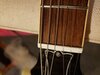
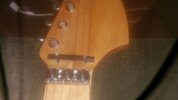
My wife won't check it out, but do you see anything weird at the B string? A little warp maybe? Been having a hell of a time getting in tune, so I tuned the B string at the 3rd fret and it's perfect. Of course the open B is flat now. I think I need a new nut. Sorry, didn't mean to steal your thunder Mcblink.
 
Hey, Take a Look at My Nut!

It's creamy and sharp... :whistle:

How's the action at the first fret when holding down the strings after the second fret? Hopefully there is a hair of a gap and they are symetrically set to the radius of the fret board.

Can you tell if the apex of each string are all at the leading edge of the nut?

This type of stuff will mess with your intonation real bad.
 
Hey, Take a Look at My Nut!

It's creamy and sharp... :whistle:

How's the action at the first fret when holding down the strings after the second fret? Hopefully there is a hair of a gap and they are symetrically set to the radius of the fret board.

Can you tell if the apex of each string are all at the leading edge of the nut?

This type of stuff will mess with your intonation real bad.
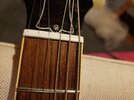
Yep, she's got gap at 1 when I fret above 2. I've checked tuning and it only happens on the B string. If I tune the others at the 3rd fret they are still all in tune open.
 
20200227_195243.jpg

That's gonna bind on the G, hasn't it? There are distinctly different hard angles coming into the nut and going out of the nut. Further, being half ontop of the nut, there's yet more friction and potential for binding, isn't there?

I'd say the same issue with the B.

Your D looks nice.

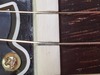
I say that because I've been rather irked with the G string on my SG Special, so took some time working the nut slots. It looks really ugly now, but I have much smoother angles, no binding at all. Since I did that (3 weeks ago or so?), the guitar has stayed in tune perfectly. :D

Here:

20200228_171429.jpg

This was the thought process: a curve coming into the nut and through the nut then leaving in a straight line to the bridge. I know it looks really ugly, but it's the best tuning stability that I've ever had with a Gibson G string, so I'm happy. I also wanted a deep channel, so there's no side or bottom friction that could contribute to binding problems.

I hasten to add: I know nothing, so the luthiers and fellas who know will probably (rightly) tell me that my solution is an awful one. :io:
 
Last edited:
I would change the strings to eliminate that variable.
The most likely culprit if I were to guess is the b string is too high at the nut.
when you fret it at 3 and tune, you are adding tension to the string as you push it down from the open position.
This may result in the open string then being flat.

If the rest of them are ok and intonation is not problematic, you nut slot is positioned correctly.
The distance from the front edge of the nut to the first fret must be correct (as well as all the frets /fret slots).

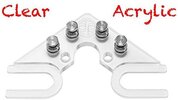
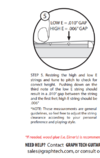
This is from the Graphtec nut installation.

I use this but eyeball the heights rather than measure, for all strings as sometimes the nut slots do not follow the fret board radius accurately.

I leave my lo e and A strings slightly higher to compensate for my ham fisted chord picking/strumming or they buzz, esp. at 25 1/2" scale.

nut string height.png
 
One of the flaws in Gibson string path design is the string angle to the tuning pegs. PRS guitars kinda corrected this if you look at there headstocks. Course Fender has the straight path from strings to tuning pegs but you need those string trees.i prefer the OFR method. Im always pullin and tugging and dinkin with my Gibson style guitars tuning.Not so much with the Fenders.Just the way it is.Nothin is perfect.1582904252102-570182926.jpg
 
Back
Top