OP


I'm still trying to work out this diagram in my head.....


Keep in mind what happens in potting. The windings are prevented from moving or vibrating. That's it. The mere presence of wax doesn't affect tone. If a pickup is already wound tightly enough and the windings aren't vibrating much, you very likely won't tell much of a difference.I've read that potting makes a pickup less responsive. Ive never noticed.
Of course, it's only opinions and conclusions after all....
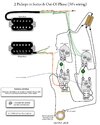
This is somewhat understand:
View attachment 27376
This is how Seymour wired Randy Rhoads" white Concorde.
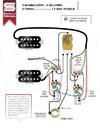
This one makes no sense to me at all:
View attachment 27377
Note the top diagram's use of capacitors compared to the bottom diagram....
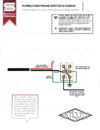
Maybe, I can help a little.
That last diagram is a typical coil split arrangement. It is not a phase reversal diagram. It's pretty much exactly how I wired the coil split for my LP Studio, except I chose to use the push/pull pots in the volume position rather than the tone position, for more immediate access. I also used 50's wiring instead of modern. The way a coil-split works is that one coil is simply short-circuited to ground.
The difference in the capacitor connection schemes you pointed out is because the top diagram depicts '50s wiring. The bottom one shows modern wiring.
The only meaningful difference between '50s and modern wiring is that in '50s wiring the tone circuit taps off the wiper (center lug) on the volume pot. This is the output of the pot. Modern wiring taps off the input of the volume pot, which is the connection directly from the pickup.
The tone circuit, itself, is a series circuit consisting of the pot resistance and the capacitor leading to ground. Electronically, it doesn't really matter if the resistance or the capacitor is first. The main distinguishing feature between the two tone schemes lies in where the tone circuit taps off the volume pot.
However, getting back to the original idea of doing a phase reversal, the top diagram is showing both a phase reversal and a series/parallel pickup setup. For a simple phase reversal you only need one push/pull pot. I've never tried doing the series switching.
As I suggested earlier (post #12), for a simple phase reversal, I'd ignore that top diagram. Instead, just wire one pickup to it's volume and tone like you'd normally do, without using any push/pull pot. It doesn't matter which pickup you choose. I tend to choose the bridge pickup. However, the second pickup should be wired to the push/pull pot as illustrated below:
Note the comment in this illustration. The hot lead from the switch (that black wire coming from the lower left switch terminal), will get connected to the input of the volume pot. From there, the volume and tone will be wired normally.
View attachment 27392
Keep in mind what happens in potting. The windings are prevented from moving or vibrating. That's it. The mere presence of wax doesn't affect tone. If a pickup is already wound tightly enough and the windings aren't vibrating much, you very likely won't tell much of a difference.
But, for a pickup that has started to get a little loose, the before and after is a little more obvious.
This can be one reason why the impressions of people can vary so much.
....and experiences. That's part of what forums do...they allow us to share experiences and learn.
That's helpful, Smitty...thank you.
I ordered 2 standard TAOT/CTS pots 525k and 2 push/pull TAOT/CTS 540k pots, so I will be using both push/pulls on the tone controls.
Referring to the Randy Rhoads' Concorde diagram, it refers to phase split with one pot and series with the other.
Can you explain that precisely???
I'll try...without getting too techno-babblish….
First, it's not "phase split". Wiring for splitting and phase reversal are two different things. The Concorde diagram is using one push/pull pot to put switch one pickup out of phase with the other.
The series connection is doing something entirely different. In a normal setup, the pickups are connected in parallel with one another. In fact, almost all wiring schemes, regardless of the whether you have two or three pickups, they are wired in parallel. Pickup windings have a "start" and a "finish" (for simplicity I'm speaking in terms of a two-wire pickup). In a parallel connection, the starts are connected together and the finishes are connected together.
Now, of course, you are not physically soldering the two pickups together - this parallel connection occurs in the toggle switch when you select both pickups. The finishes are connected to ground, which is how they are joined.
What's happening with series switching is that the wiring of one pickup is switched to be in series with the other one. This means one pickup feeds INTO the other. That's what that second push/pull pot is doing. In a series setup, the finish of one pickup connects to the start of the second pickup. The finish of the second pickup goes to ground. This makes for more complex wiring.
Like capacitor drift???


What benefit would be obtained???
Obtained from what?
Series wiring?
I'm sorry...yes...series wiring...
I’ve never tried it so I have no first hand experience with it.
All I could tell you is what various sources on the inter webs say about it.
 www.haloguitars.com