Low Power Large Tubes Amp ;-)

bea

AmBASSador of the F Clef
Country flag
Well, the following is about recycling stuff i've lying around...

Yes, an amp (my bass building projects need to rest for a while, and i want to use these long winter nights...). Taking the chassis from a 70´s Dynacord amp which burnt down more or less completely. Taking the transformers from an EL84-PP kit i failed to complete 8 years ago due to lack of knowledge and even more lack of measuring equipment.

But the chassis wants 8-pin sockets. And yet another EL84 amp is boring, isn't it?
So it must be 6L6GC. Let's see what i can obtain from them...

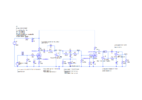
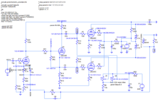
Here the schematics, taken from a spice simulation - not the latest version, but almost:
6L6PP_3.small.png

Here the preamp:

Preamp_ECC83.4.png


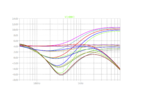
and the frequency response from linear to hiwattish with just two controls:
Preview of “Preamp_ECC83.4”.png


And now some amp guts:

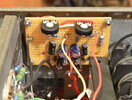
Bias supply: a symmetric 6-fold cascade making 52V from a 6.3V heater supply. I would need even larger caps in order to further reduce the remaining hum, but for now it is almost inaudible.
DSC_3958.JPG


And here "everything" - power stage except preamp.
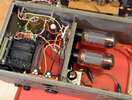
DSC_3960.JPG


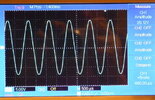
12 almost clean watts from 2 6L6GC:

DSC_3954.JPG
 
Last edited:
this looks very technical --- Im sure Drumoid and others will be able to decifer this------I have no idea what I am looking at----
BUT-=--it LOOKS POWERFUL.....and like it will really SHAKE SOME FOUNDATIONS!
so I approve ;)

ANd also-- a HAPPY NEW YEAR to you bea.
 
On of the amps i have already shown here gives 22W with two 6L6GC.


The power always depends on the voltage and the current the power supply can deliver at this voltage. A tube is nothing else than a controllable resistor which modulates that current with the input signal. So if You have 200 mA at 300V available you get more or less the same output regardless of the actual tube.

Which means that You cannot expect more power from an EL84-transformer set
(and i actually tried to squeeze out a little bit more power from the transformers, but that worked only in the simulations but failed in reality....)

For more power i would, for example, need at least a larger anode voltage. at the same current. And that could mean i could stack th eoutput of another PSU giving me, say, another 30 Volts, in order to increase the power of the amp.
 
Makes sense. I have a Traynor YCV80Q with four 6L6s that puts out 80 watts. Those tubes are capable of much more but as you say the final output is determined by the design of the amp.
 
Last edited:
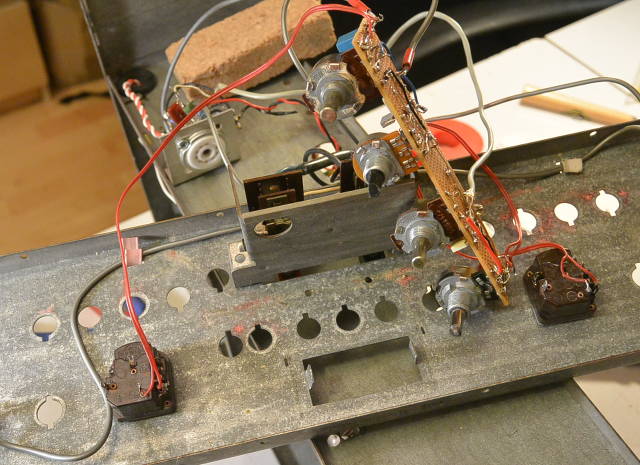
While i was making the preamp i found many details where the design shown above needed to be improved or changed. Well, it looks as if i were almost done: wiring complete. Before triple checking and testing it'll probably be better to make a break.

You see the controls (Gain, Tone, Mids, Master) and in the background the tube socket. Still without tube. Which will be an ordinary ECC83.

DSC_3967.JPG
 
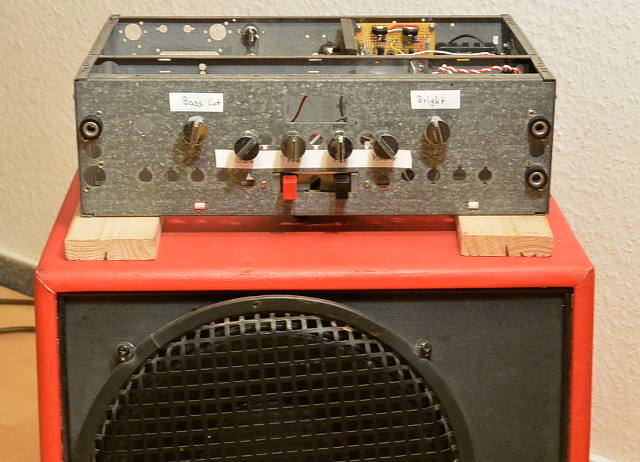
Ready to take off (not at 3:15 in the night, of course...). It looks as if i'd need to tweak the local NFB loop i added to the 2nd stage, and of course, the global NFB loop of the power stage - find a good compromise between bandwidth and "overdriveability". If i'm lucky, everything is fine.

DSC_3969.JPG
 
... well, it is almost perfect. A very clean amp which sounds like a big one. Very close to the G-2000 or even a Hiwatt. Cleaner as my old Bouyer, which alsways has some (nice) grit in the tone. A perfect studio amp, and sufficient for a home session.
Over time it might get a bit of tweaking in the tone stack, but it is mostly ok as it is.
 
BTW: What Do You think of "Little BeaR" as the name of the amp?

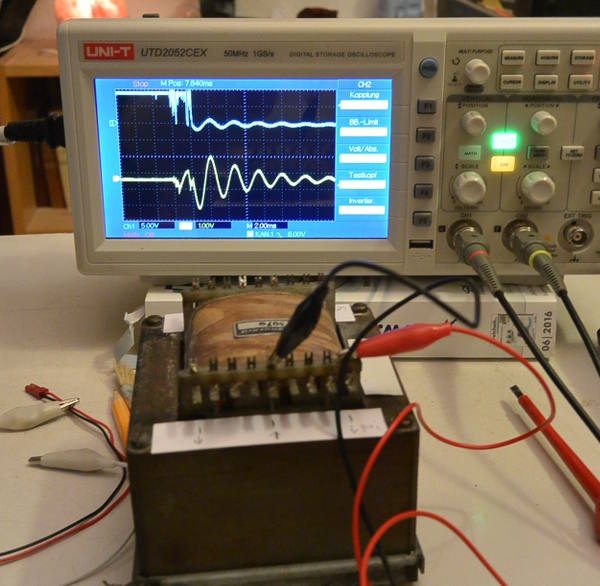
Here a first test for its bigger brother - is the old OT still ok?
DSC_3970.JPG


This iron should be capable of up to 110 Watts. That's what was originally in the headshell. The PT needs still to be tested. If it is ok, then this might turn into an amp squeezing 70-90W from a pair of EL34 or KT77 running at 750V.
 
@bea - Forgive my ignorance, but is not the purpose of a tube in an amplifier to act like a step-up transformer??? Raising voltage and current????
 
Mhmm, i'm not sure what You mean with Your question. My little amp raises voltage and current.
 
Bea, I can't wait to get a good look at this and add to my rudimentary understanding of schematics and circuit design.
I commend you for putting your knowledge into actual hardware.

Can't wait to see how you like what you come up with.
 
Back
Top