ivan H
Ambassador of Tubes & Grooves

I first built my main amp, a 4 hole 50 watt m@rsh@ll clone around 11 yrs ago, using commonly available carbon film resistors & Mallory 150 series metalized polyester film capacitors. Tweaked to a spec I was happy with using features from the '67 & '68 50 watt amps, it has served me well & sounded very good. Over the years however, I often thought about a build using more "period correct" components, so started slowly gathering components.
Now I must say a very big "thank you" & "very much appreciated" to one Mr RVA for his assistance in acquiring a complete set of period correct Iskra resistors, without which this project would still be in the "parts aquisition" stage, so thank you very much Ray, you are a scholar & a gentleman. So, with parts acquired the amp was stripped to this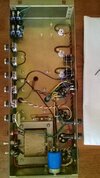
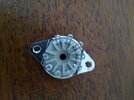
Cleaned up & new ceramic pre amp tube tube sockets installed (to replace micalex ones), the board cleaned up & re turreted & rewired, then installed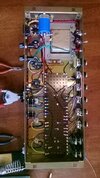
& then populated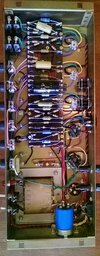 The C296 mustard caps are mostly Philips Mullards, the exceptions being the 0.0022uf V1B coupling cap, which is an Aussie made Philips Miniwatt, made at the Hendon SA plant, & the two 0.68uf/160V V1B & V2A cathode bypass caps, which are Spanish Philips Bianchi types. These "foreign" mustards are made on the same machine types as the Mullards, with the same material stock supplied by parent company Philips, so while never used in Marshall's, they're the same cap type. Not what you'd use in a vintage Plexi restoration but plenty good for clone amps. The HT voltage dropping resistors are period correct 1 watt RS morganites. The treble & treble peaking caps are 60's era RBS 2% 560pf silver mica's. I'm still looking for two RS types for these positions. Volume 1 bright cap is a 4700pf/1000V Lemco ceramic disk, though this may well be changed to a smaller value.
After going through all checks I installed the same valves that had previously been in it, power tubes biased to 66%.
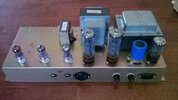
So how does it compare? Well it's noticeably different & to my ears for the better. Much smoother, mids are more open. Seems richer with better harmonic content & has that "note bloom" thing happening much more than it did before. After putting about an hour on it I changed out the tubes for the new ones I had for. Rectifier is a NOS/NIB Valvo branded f32 Blackburn Mullards GZ34. EL34's are the same (St Petersburg) Winged C's that have been in it. Of the two NOS Brimar CV4004's that I had for it, the first that I tried in the phase inverter position gave a plate differential voltage of close to 11v, so it was relegated to the V2 spot. The other Brimar in the phase inverter socket gives a plate differential voltage of 7.8v, a little higher than I'd like but still in the ballpark & will do for now. V1 is a NOS Mullard 163 series 12AX7. I've put around 5 hours on the amp with these tubes in & really like the grit of the 163 Mullard in V1, however it is just a little noisey (not microphone, just a tad noisey on the bright channel). I do have a NOS/NIB factory matched duet of Mullard XF2 EL34's & another 163 series 12AX7 on the way so plan on doing some tube rolling & maybe a couple of small circuit tweaks as the amp settles in & will then try to get a couple of clips up. A couple more pics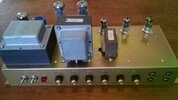
Cheers
Now I must say a very big "thank you" & "very much appreciated" to one Mr RVA for his assistance in acquiring a complete set of period correct Iskra resistors, without which this project would still be in the "parts aquisition" stage, so thank you very much Ray, you are a scholar & a gentleman. So, with parts acquired the amp was stripped to this
Cleaned up & new ceramic pre amp tube tube sockets installed (to replace micalex ones), the board cleaned up & re turreted & rewired, then installed
& then populated
The C296 mustard caps are mostly Philips Mullards, the exceptions being the 0.0022uf V1B coupling cap, which is an Aussie made Philips Miniwatt, made at the Hendon SA plant, & the two 0.68uf/160V V1B & V2A cathode bypass caps, which are Spanish Philips Bianchi types. These "foreign" mustards are made on the same machine types as the Mullards, with the same material stock supplied by parent company Philips, so while never used in Marshall's, they're the same cap type. Not what you'd use in a vintage Plexi restoration but plenty good for clone amps. The HT voltage dropping resistors are period correct 1 watt RS morganites. The treble & treble peaking caps are 60's era RBS 2% 560pf silver mica's. I'm still looking for two RS types for these positions. Volume 1 bright cap is a 4700pf/1000V Lemco ceramic disk, though this may well be changed to a smaller value.After going through all checks I installed the same valves that had previously been in it, power tubes biased to 66%.
So how does it compare? Well it's noticeably different & to my ears for the better. Much smoother, mids are more open. Seems richer with better harmonic content & has that "note bloom" thing happening much more than it did before. After putting about an hour on it I changed out the tubes for the new ones I had for. Rectifier is a NOS/NIB Valvo branded f32 Blackburn Mullards GZ34. EL34's are the same (St Petersburg) Winged C's that have been in it. Of the two NOS Brimar CV4004's that I had for it, the first that I tried in the phase inverter position gave a plate differential voltage of close to 11v, so it was relegated to the V2 spot. The other Brimar in the phase inverter socket gives a plate differential voltage of 7.8v, a little higher than I'd like but still in the ballpark & will do for now. V1 is a NOS Mullard 163 series 12AX7. I've put around 5 hours on the amp with these tubes in & really like the grit of the 163 Mullard in V1, however it is just a little noisey (not microphone, just a tad noisey on the bright channel). I do have a NOS/NIB factory matched duet of Mullard XF2 EL34's & another 163 series 12AX7 on the way so plan on doing some tube rolling & maybe a couple of small circuit tweaks as the amp settles in & will then try to get a couple of clips up. A couple more pics
Cheers
Last edited:


 .
.